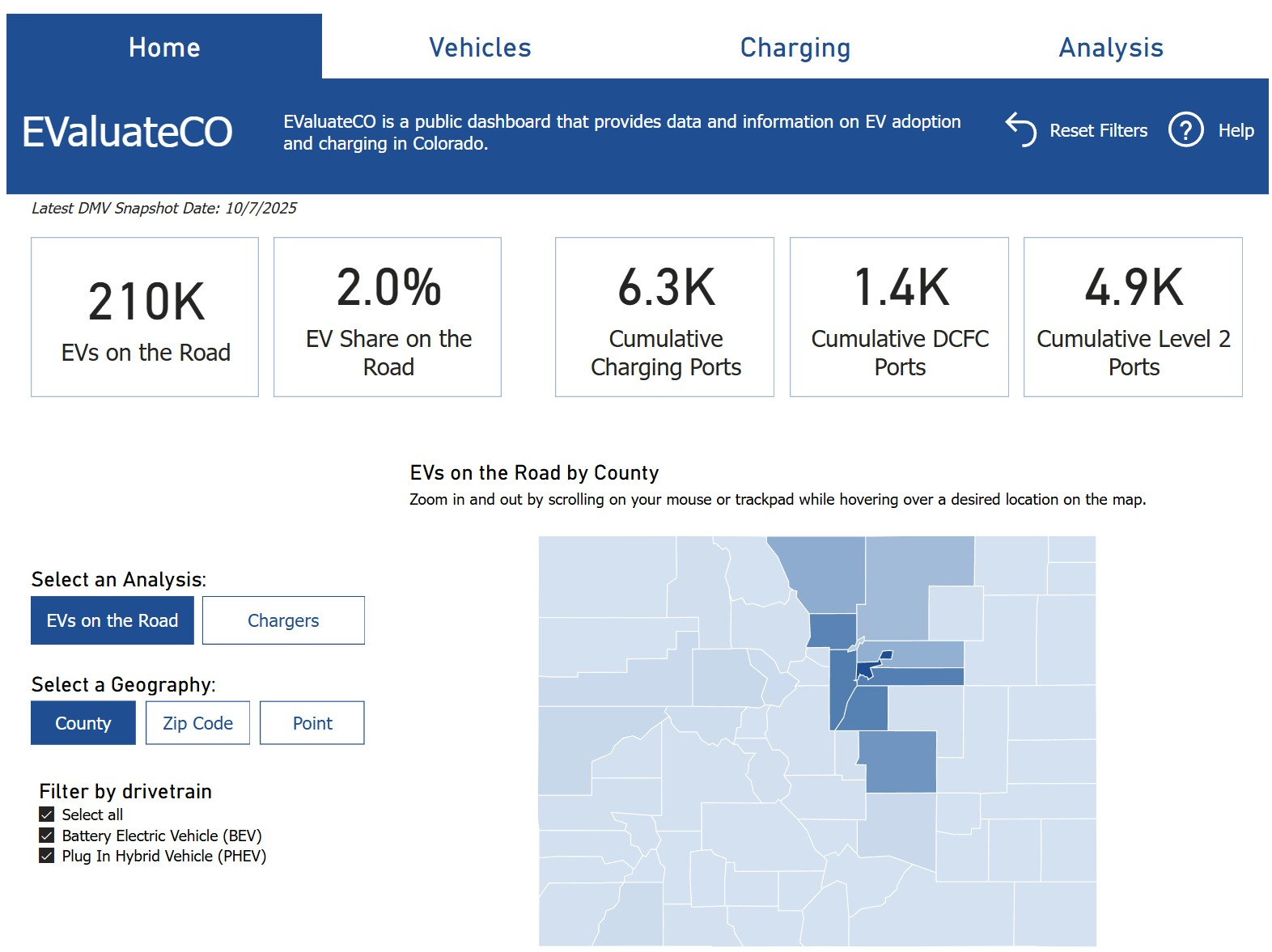
EValuateCO is a comprehensive dashboarding tool that provides insight into the current state of vehicle electrification in the state of Colorado. The dashboard allows people to view information on electric vehicle (EV) deployment, current statewide EV infrastructure, and details on charging use for a selected number of Charge Ahead Colorado (CAC) funded stations. It is a great resource for anyone seeking information on vehicle electrification in Colorado. Where distinguishable, EVs may be separated by battery EVs (BEVs) and plug-in hybrid EVs (PHEVs).
This dashboard was recently revamped. For any questions or concerns, please reach out at [email protected].
- The state vehicle registration data is from the Colorado Department of Motor Vehicles. For more information on how Atlas processes this data, please visit State EV Registration Data.
- Data on charging locations is from the U.S. Department of Energy.
- Charging use and cost data for stations funded by CAC are provided by Blink, ChargePoint, EV Connect, EVGateway, EVGo, Rivian, and Tesla.
- Demographic information is provided by the U.S. Census Bureau.
- Electric utility data is sourced from the U.S. Energy Information Administration, including electric utility territories by county when ZIP Code–level data is unavailable.
- Electric utility territory data by ZIP Code is provided by OpenEI.
- Retail electricity price data is sourced from the U.S. Energy Information Administration.
- ZIP Code, city, county, and latitude/longitude reference data is provided by UnitedStatesZipCodes.org.
EValuate Colorado has been designed to be accessible to all users. All visuals include alternative text and the tab order has been set to provide an intuitive experience for users to navigate the dashboard without the use of a mouse. A high-contrast mode of the dashboard is available to users through browser extensions. Atlas recommends using the following extensions:
- Microsoft Edge: Windows High Contrast Mode
- Google Chrome: High Contrast Extension by Google
- Firefox: Dark Reader Extension by Alexander Shutau
Do you have suggestions on how we can make EValuate Colorado more accessible? Let us know at [email protected]
Statement from the Colorado Energy Office
The Offices of the Colorado Governor, including the Colorado Energy Office, are dedicated to supporting a welcoming, inclusive, and accessible Colorado for all.
Our ongoing accessibility efforts work toward being in line with the Web Content Accessibility Guidelines (WCAG) version 2.1, level AA criteria. These guidelines not only help make web content accessible to users with sensory, cognitive, and mobility disabilities but ultimately to all users, regardless of ability.
Our efforts are part of a meaningful change in making all State of Colorado services inclusive and accessible. We welcome comments on how to improve our technology’s accessibility for users with disabilities and for requests for accommodations to any State of Colorado services.
EValuateCO includes data on EV adoption and EV charger deployment in Disproportionately Impacted Communities (DICs). DICs are defined based on the Transportation Equity Screening Tool for Colorado Energy Office Transportation Programs. The statutory definition of DICs is available on Colorado EnviroScreen.
View EV adoption and EV charger deployment in DICs on the Vehicles and Charging Pages.
The dashboard is interactive by default and allows the user to hover over elements to see more details, click on segments of a chart to cross-filter other charts in the same section, and drill down into areas of interest in certain visuals. Additionally, there is a yellow filter bar on the right side of the dashboard. This allows the user to filter the visuals to view specific information of interest. Feel free to explore the dashboard and click around. You can always go back to the default view by clicking the “Reset Filters” button on the top right of each page.
This dashboard is organized into four separate tabs: Home, Vehicles, Charging, and Analysis.
- The ‘Home’ tab provides an overview of the EV market and charging station deployments across the state.
- The ‘Vehicles’ tab provides a more detailed overview of EV deployment in Colorado, including vehicle details like location, make, model, year, class, and type.
- The ‘Charging’ tab provides more information on Colorado’s public charging stations, including locations, power levels, connector types and networks. Where provided, charging use and cost data is also available.
- The ‘Analysis’ tab allows the user to do a side-by-side comparison of different locations in Colorado to analyze trends in EV adoption and charging station deployments.
Yes. Hover over a visual or chart and click on the three horizontal dots on the top right corner. Then select “Export data”.
Yes. Keyboard shortcuts are available when you enter the dashboard. To navigate into the dashboard, press Ctrl + Enter and then select the “Skip to main content” link within the context menu to set focus to the top navigation bar with the tab buttons visible. Once focus is on the top navigation bar, press enter. You can then tab across the bar and press enter to select a page for navigation.
To expand the rows of a matrix, you can press Shift + Right Arrow Key. You can see other commonly used keyboard shortcuts by pressing Shift + ? once you’ve navigated your cursor to being inside the dashboard.
Do you have suggestions on how we can make EValuate Colorado more accessible? Let us know at [email protected]
An original registration is a vehicle that shows up in the database for the first time and could either be a new sale or an imported vehicle from out of the state.
Measures referring to recent model years only include vehicles whose model years are within 18 months prior to the most recent Division of Motor Vehicles (DMV) snapshot. This distinction helps users distinguish the differences in trends between older vehicles versus newer vehicles in Colorado.
- EVs on the Road is a point‑in‑time metric that only includes vehicles appearing in the DMV data set for a given snapshot date with an active, unexpired registration. Because it reflects the current, active population of vehicles in the state, this number can move up or down over time—vehicles may lapse in registration, leave the state, or fluctuate due to unique local factors such as rental fleet turnover. This measure is not cumulative and does not include EVs that were previously registered but are no longer active.
- EV Registrations (Original Registrations), by contrast, represent the first time a vehicle’s identification number (VIN) appears in the state DMV database, including both new EV sales and used EVs imported into the state. Once a VIN has been recorded, it remains part of the historical dataset even if the vehicle is no longer active.
Vehicle registration data from the Colorado DMV is updated on a monthly basis. Charging location data is updated at the discretion of the U.S. Department of Energy, while charging use and cost data from participating providers is updated on a quarterly basis. The date for the last snapshot from the DMV will be noted in the top right corner of the ‘Home’ tab.
We welcome feedback! If you have additional thoughts to share with us on the dashboard or the scope of the project, we would love to hear from you.
Get in touch: [email protected]
Subscribe to Receive the Latest News from Us
We’ll update you when we have something to share.